
Gangotri to Gaumukh Trek Guide 2026: Route, Permit & Expert Tips
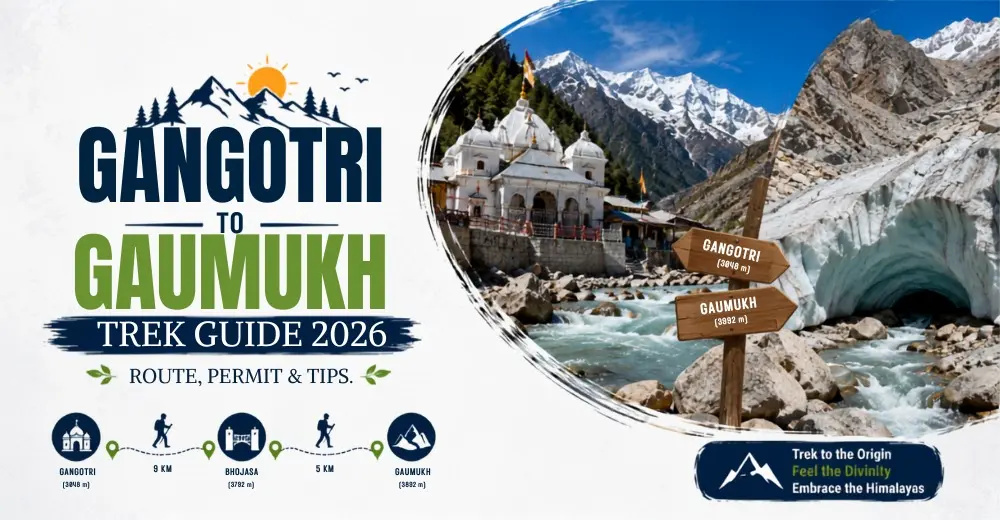
The Gangotri to Gaumukh trek is one of India’s most iconic pilgrimage and adventure trails. This trek takes you to the Gangotri National Park and to the Gaumukh Glacier, which’s the starting point of the River Ganga.
To plan this trek in 2026, you need to know about the rules and regulations. You need to know about the guides, the permits, and the rules to protect the environment.
Trek Overview & Key Metrics
Before we start with the travel plan, here’s a quick review of what you can expect on this journey.
Total Distance: ~36 km (Round trip from Gangotri)
Highest Altitude: 4,023 meters (13,200 feet) at Gaumukh Snout
Difficulty Level: Moderate (Involves steady inclines, rocky terrain, and boulder crossings.)
Duration: 3 Days / 2 Nights (Excluding travel to Gangotri)
Best Time to Visit: May to June (Pre-monsoon) and September to October (Post-monsoon)
Complete 2026 Permit Guidelines & Mandatory Rules
The Uttarakhand Forest Department strictly regulates entry to Gangotri National Park to help protect its beautiful and delicate natural environment.
1. The 150-Trekker Daily Cap
Only 100-150 permits are issued per day on a first-come, first-served basis. It is highly recommended to book your permit at least 30 to 45 days in advance, especially during the peak months of May and June.
2. How to Apply for the Permit
• Online Registration: Online registration is no longer available. The travel agent through whom you are booking your tour will arrange the required permit for you.
• Offline Verification: Bring a printed copy of your online permit to the District Forest Office (DFO) in Uttarkashi or the Forest Checkpost in Gangotri town for final physical verification before starting the trek.
3. Mandatory Documents and Requirements
• Government-issued ID: Aadhaar card, passport, or voter ID.
• Medical Fitness Certificate: Issued by a certified doctor within 15 days of the trek start date, confirming you are fit for high-altitude trekking.
• Mandatory Local Guide: You cannot trek to Gaumukh without a registered local guide. You must provide your guide’s credentials and registration number when finalizing your permit.
• Trek Insurance: Valid high-altitude travel insurance covering emergency evacuation is now mandatory for all trekkers.
• Age Restriction: People aged 60 and above are required to have a medical certificate, and those aged 75 and above are not allowed because there is a risk of health deterioration.
4. Eco-Rules and Plastic Security Deposit
The national park does not allow single-use plastic bottles and bags at all. When you get to the Gangotri checkpoint, the forest officials will look at the plastic things you have with you, like the wrappers from your food or your own water bottle. Then they will take a deposit of money from you that you will get back later. They do this to make sure you do not throw away the plastic items inside the national park. The officials at the Gangotri checkpoint are very serious about keeping the park clean and free of single-use plastic bottles and bags.
Day 1: Arrival and Acclimatization at Gangotri (3,100 m)
Your journey begins with a drive from Dehradun or Rishikesh to Gangotri. This is a drive of around 240 kilometers that takes about 8 to 10 hours.
Spend the day just resting in Gangotri town. It is very important to get used to the altitude here so that you do not get sick. In the evening take a walk to the Gangotri Temple or the Surya Kund. This will help your body get used to the altitude, at Gangotri.
Day 2: Trek from Gangotri to Bhojbasa via Chirbasa (14 km | 6–7 Hours)
• The Trail: Start your trek early in the morning from the forest checkpost just above Gangotri temple. The trail is well-defined and climbs gradually alongside the roaring Bhagirathi River.
• Chirbasa (9 km): You have to walk for 4 hours through the pine forests to get to Chirbasa. This place is also called the Abode of Pine trees. When you reach Chirbasa. Have your lunch. From Chirbasa you can see the Bhagirathi mountain peaks clearly for the first time.
• Bhojbasa (5 km): When you walk for another 2 to 3 hours, the scenery around you changes. You will see that the green forests are gone and now you are, on mountain paths. This is how you get to Bhojbasa. where most people set up their camps for the night. It is the place to stay overnight in Bhojbasa. You need to pay if you set up your tent or camp in Bhojbasa.
Day 3: Bhojbasa to Gaumukh Snout & Return to Gangotri (22 km | 8–9 Hours)
Wake up early in the morning to see Mt. Shivling shining in the morning sun. The path from Bhojbasa to Gaumukh is really tough with steep parts and lots of big rocks all over the place.
• The Snout: When you get to reach Gaumukh, you can see the part where the Ganga River comes out.
• Safety Alert: You can see the Gangotri glacier from afar, and you should not go closer than 500 meters because Uttarakhand Tourism says so. There are a lot of rocks falling down near the mouth of the glacier.
• After you have seen all the views walk back, to Bhojbasa for the night to rest.
Day 4: Bhojbasa back to Gangotri (14 km | 4–5 hours)
You go down the same way, and this brings you back to Gangotri town by early afternoon. When you get to Gangotri town you can catch a vehicle that will take you back to Uttarkashi or Dehradun.
Where to Stay & Eat
• Gangotri: You can find budget ashrams, hotels, and local homestays. There are options for Gangotri accommodations. Gangotri has plenty of choices so you can pick what suits you best.
• Bhojbasa: You are not allowed to camp at Gaumukh. Gaumukh has a rule that does not let you stay overnight. People who go on treks usually stay at Bhojbasa. At Bhojbasa you can stay in a guest house or dorms that are run by Garhwal Mandal Vikas Nigam or, at an ashram. It is an idea to book the Garhwal Mandal Vikas Nigam tents or book rooms online before you go.
• Food: The meals they serve are simple. They fill you up. You can get food at the dhabas and ashrams. They have food like dal and rice and roti and sabzi and noodles. Food, at these places is all vegetarian. You will not find non -vegetarian food or alcohol inside the national park zone.
Best Time to Visit in 2026
The trek has two best times of the year to visit.
1• Pre-Monsoon (May to mid-June): The skies are clear and sunny. There are a lot of beautiful alpine flowers in bloom. The trail usually closes by the end of June because of the big risk of landslides happening.
2• Post-Monsoon (Mid-September to mid-October): The mountain views are really sharp and crisp. At night it gets very cold the temperatures are freezing.
Avoid July and August completely due to heavy monsoon rains disrupting the mountain roads.
Pro-Tips for a Successful Trek
• Carry Liquid Cash: When you go away from Gangotri, you will not have cell service. ATMs in Gangotri usually do not have any money, or they have problems with the internet, so you should carry a lot of money with you. You will need this money to pay your guide, stays, and emergency expenses.
• Power Backup: Cold weather drains electronics quickly. Bring a heavy-duty power bank and keep your phone or camera batteries wrapped inside warm clothes.
• Eco-Friendly Rule: When you go to the Gaumukh Trek, the security of the forest department will count how many plastic bottles and wrappers you have with you at the check post. You need to bring the same number of plastic bottles and wrappers to get your money back that you paid as a security deposit. The forest department wants to make sure you do not leave any bottles and wrappers in the forest.
Frequently Asked Questions (FAQ)
1. Is a guide mandatory for the Gaumukh trek in 2026?
The Uttarakhand Forest Department says that every trekker must go with a guide from the area who is registered. This is so that the Uttarakhand Forest Department can make sure people are safe while they are trekking. The Uttarakhand Forest Department also wants to make sure that if someone gets hurt, they can get help right away. The Uttarakhand Forest Department does not want people to throw trash in the national park. So the Uttarakhand Forest Department makes sure that every trekker has a registered guide with them.
2. Can I stay overnight at Gaumukh?
No, overnight camping or staying at Gaumukh is strictly banned to protect the glacier. The nearest legal overnight halting point is Bhojbasa (4 km before Gaumukh), where you can stay at the GMVN tourist camps or local ashrams.
3. How difficult is the Gangotri to Gaumukh trek?
The trek is not that hard. It is not easy either. The path to Chirbasa is pretty okay; it is gentle. When you go from Bhojbasa to Gaumukh, the trek becomes tough. You have to walk on rocks and loose dirt; it is not a smooth walk. If you want to do the trek, you should be in shape and get used to the high place in Gangotri first. The trek is called moderate. You should still be careful. You need to be physically fit and get used to the place before you start the trek to Gaumukh.
4. Is mobile network available on the trail?
No. All mobile networks (including BSNL, Jio, and Airtel) disappear completely once you cross the forest check-post outside Gangotri town. Inform your family beforehand and carry cash, as digital payments (UPI) will not work.
5. Can I get a permit offline directly in Gangotri?
No. The offline permit has been discontinued by the government; now only online permits are issued.